



When families choose cremation, one of the first questions that follows is where their loved one’s ashes can go. It sounds like it should have a simple answer. It doesn’t — but the answer is probably less restrictive than you’re expecting.
Here’s the short version: no Florida law tells you where you may keep or scatter a loved one’s ashes. The real limits come from three places — federal rules that apply out on the water, permission from whoever owns the land, and the individual policies of parks and preserves. Once you understand which of those three you’re dealing with, the rest is straightforward.
This guide walks through the 2026 rules for scattering at sea, on land, and from the air, and explains one piece of misinformation that trips up nearly every family we speak with.
The one thing most families get wrong
You’ll read on a lot of websites — including some Tampa Bay charter operators’ own pages — that you must apply for a permit before scattering ashes at sea, or that you must notify the Coast Guard afterward.
Both are incorrect, and we want to clear them up before anything else:
- There is no permit to apply for. The EPA has already issued a blanket authorization, called a general permit, that covers everyone. You don’t submit an application, you don’t pay a fee, and you don’t give advance notice.
- The Coast Guard is not the agency you report to. The EPA is.
What you actually owe is a report to the EPA within 30 days after the scattering. That’s it. Nothing beforehand.
We mention this first because we’ve watched families delay a ceremony for weeks waiting on a permit that was never going to arrive.
What Florida law actually says
Florida’s cremation statutes are focused on the process itself, not on what happens afterward.
State law requires written authorization from a legally authorized person before any cremation can take place (FS 497.607), and sets the order of priority for who that person is. Florida law also addresses what happens to remains that go unclaimed — after 120 days, the funeral establishment may dispose of them.
What Florida law does not do is restrict where you may keep, store, or scatter ashes. There’s no state permit, no registry, and no list of approved locations.
So the useful question isn’t “is this legal in Florida?” It’s “who controls this land or water, and what do they allow?”
Scattering at sea: the federal rules
Scattering in the Gulf is the most popular choice for Tampa Bay families, and it’s the one area where real federal requirements apply. They come from the Marine Protection, Research, and Sanctuaries Act (MPRSA), and the specific rule lives at 40 CFR 229.1.
The requirements
Distance: at least 3 nautical miles from land. This is the big one. “Land” here has a technical meaning — it’s measured from the baseline of the territorial sea, which includes closing lines drawn across the mouths of bays. In practical terms for our area, that means scattering inside Tampa Bay itself does not qualify. You need to be out in the Gulf.
Depth: no minimum. Cremated remains may be released in ocean waters of any depth, as long as you’re far enough offshore. (Full-body burial at sea is different and requires much deeper water — that rule doesn’t apply here.)
Materials: everything you release must break down. Ashes may be scattered directly, or in a container that dissolves. Flowers and wreaths are welcome as long as they’re made of materials that decompose readily in seawater.
Reporting: within 30 days, to the EPA. Use the EPA’s online Burial at Sea Reporting Tool. The report goes to the EPA Region the vessel departed from — for Tampa Bay, that’s Region 4.
What is not allowed
- Releasing remains within 3 nautical miles of shore
- Scattering pet remains, alone or alongside a person’s
- Placing anything that won’t decompose — plastic or metal flowers, non-biodegradable urns, markers, plaques, or memorial objects of any kind
Who files the report?
This is worth pausing on. The obligation belongs to the person conducting the scattering — not automatically to the charter company. Many reputable operators handle it as a courtesy, and many don’t. Ask directly when you book, and get the answer before you’re standing on the deck.
Where the Coast Guard actually fits in
The Coast Guard doesn’t issue scattering permits and isn’t the agency you report to. But it does matter — just not in the way most articles suggest.
The Coast Guard regulates the boat, not the ashes. A commercial charter carrying paying passengers must operate under a USCG-licensed captain, and above certain passenger counts, aboard a USCG-inspected vessel. When you’re comparing charter operators around Clearwater, St. Pete, or Anna Maria, that licensing is a meaningful quality signal — an operator who advertises a Coast Guard Master captain and an inspected vessel is telling you something real about how they run.
Practical safety still applies. Check the marine forecast. Make sure someone ashore knows the plan. And a detail nobody warns families about: cremated remains are not powdery ash. They behave more like coarse gravel with fine dust mixed in. Always release downwind, over the leeward rail. Any experienced captain will position the boat for you — but if you’re going out on a friend’s vessel, this is the one thing to get right.
For veterans: the U.S. Navy operates a separate Burial at Sea program, offered at no cost to eligible veterans and certain family members, in which the committal is performed by a Navy vessel crew. It’s a distinct process from a private charter. Given how many veterans call the Tampa Bay area home, it’s worth asking about.
Scattering from the air
Florida has no state law governing aerial scattering. Federal aviation rules prohibit dropping objects from an aircraft that could harm people or property below — but cremated remains alone aren’t considered hazardous, so releasing them in flight is permitted.
Two things families miss:
- Release the ashes, not the container. The urn or tube stays on the aircraft. Dropping it is the part that’s prohibited.
- The 3-nautical-mile rule still applies over water. The federal general permit covers remains transported by vessel or aircraft. An aerial release over the Gulf must happen at least three nautical miles offshore, and it still needs the 30-day EPA report.
On land: it comes down to who controls the ground
There’s no single rule for scattering on land in Florida. There’s a rule for each type of place.
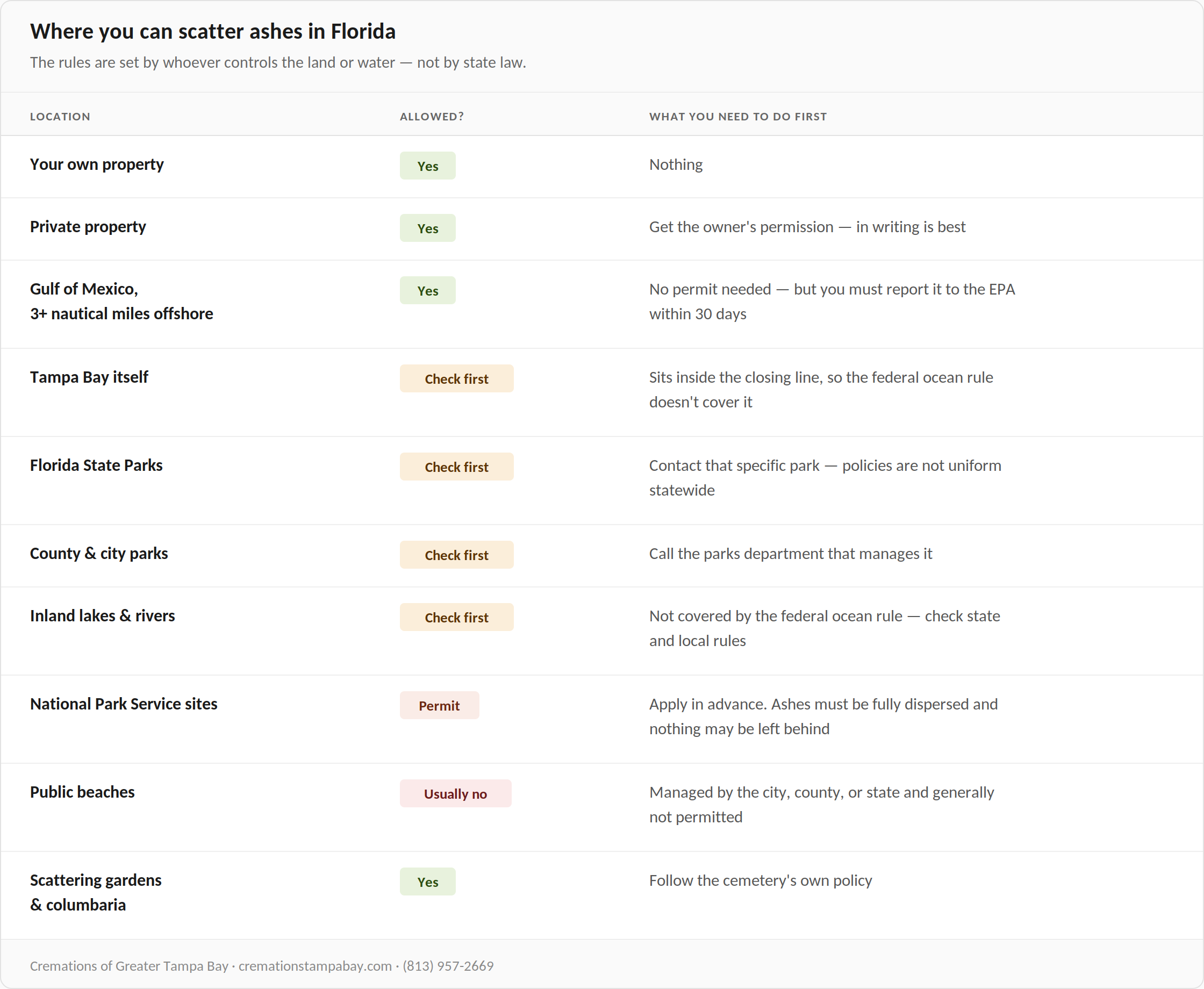
On National Park Service land, where a permit is granted, the conditions are consistent and worth knowing: remains must be fully processed with no identifiable fragments, must be fully dispersed rather than piled or buried, and nothing may be left behind — no urn, marker, plaque, photograph, flowers, or potted plants. The park won’t treat the spot as a burial ground; normal park activity resumes.
That table is really the whole point of this article. A scattering three miles out in the Gulf requires no phone calls at all. A scattering at a county park may require one. A scattering in a national park requires a permit application. Same state, same ashes, three completely different answers — because three different parties control the ground.
If you’d like specific places rather than categories, we’ve put together a separate guide: Best Places for Scattering Ashes Legally in Tampa Bay, with the local list and what each location requires.
Thinking it through: ethics and environment
Legality is the floor, not the goal.
Cremated remains are essentially bone minerals — they aren’t toxic, and they aren’t harmful to the ocean. But they’re also not nothing. Concentrated in one small area, they can shift soil chemistry enough to affect plant life. Scattering across a wide area, or trenching and letting the tide take them out, avoids that entirely.
The other consideration is simply other people. A quiet stretch of shoreline at sunrise is a different thing than a crowded beach on a Saturday. Most families find the ceremony is better for choosing the quieter moment anyway.
If the environmental side matters to your family, biodegradable urns and scattering tubes are widely available and designed to break down naturally — some are made to dissolve in water within minutes, others to nourish a tree as they decompose in soil.
If scattering isn’t the right choice
Scattering is permanent, and not every family is ready for that. It’s completely reasonable to keep the ashes while you decide — there’s no deadline, and no wrong answer.
Other options families choose:
- Interment in a cemetery or columbarium niche — a fixed place to visit
- A scattering garden at a cemetery, memorial park, or church — designated, maintained, and permanently accessible
- Keeping the urn at home, or dividing ashes among family members
- Keepsakes — jewelry, pendants, or memorial pieces made from a small portion
Many families do more than one: scatter part, keep part. That’s allowed, and it’s more common than you might think.
Put the wish in writing
If you know where you want your ashes to go — or where a loved one wanted theirs — write it down.
Florida gives the legally authorized next of kin the decision, in a set order of priority. A wish that lives only in someone’s memory can get lost in a difficult week, or become the thing a family disagrees about. Documented, it becomes something everyone can rally around instead.
This is one of the quieter benefits of cremation pre-planning — not just the cost savings, but removing the guesswork at the moment your family least wants to guess.